Safety Model
Leave an agent alone with real bench hardware and still trust the board, the host, and the logs afterwards. The agent can edit every file inside the workspace, so nothing there is trusted. All authority sits outside, beyond its reach:
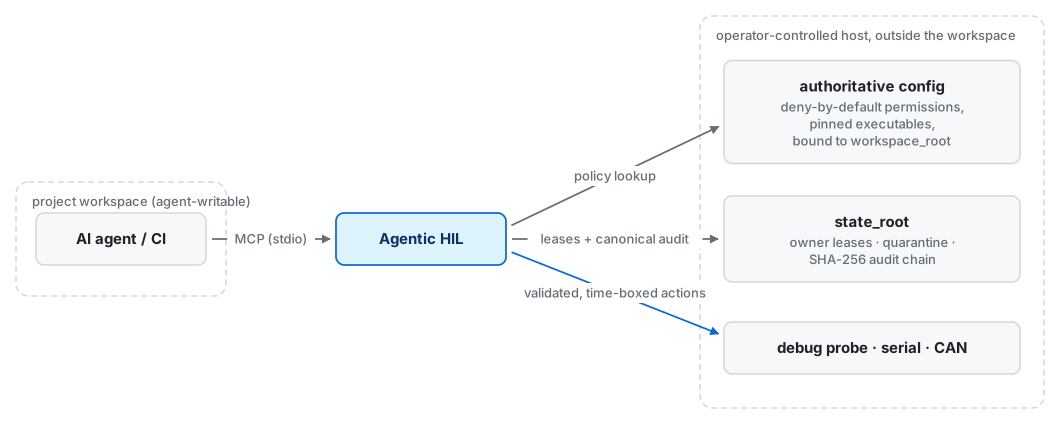
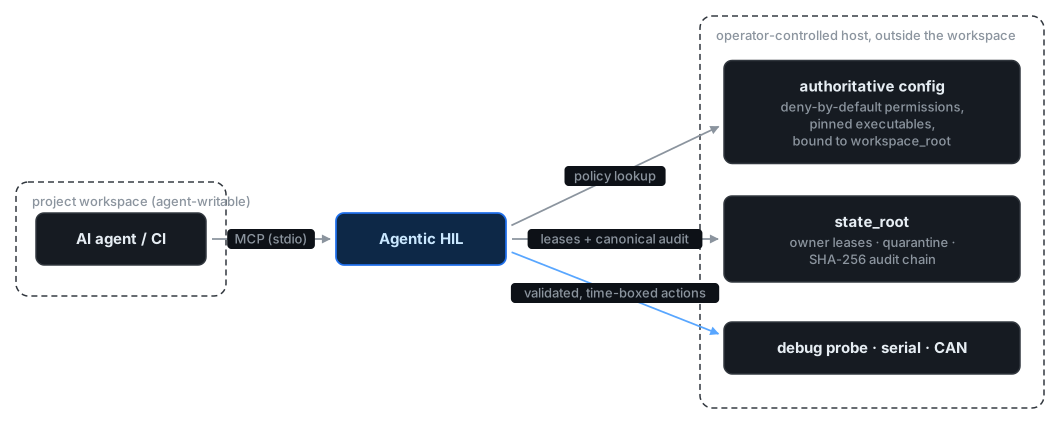
The action gate
Every hardware action, from every entry point, walks the same gate:
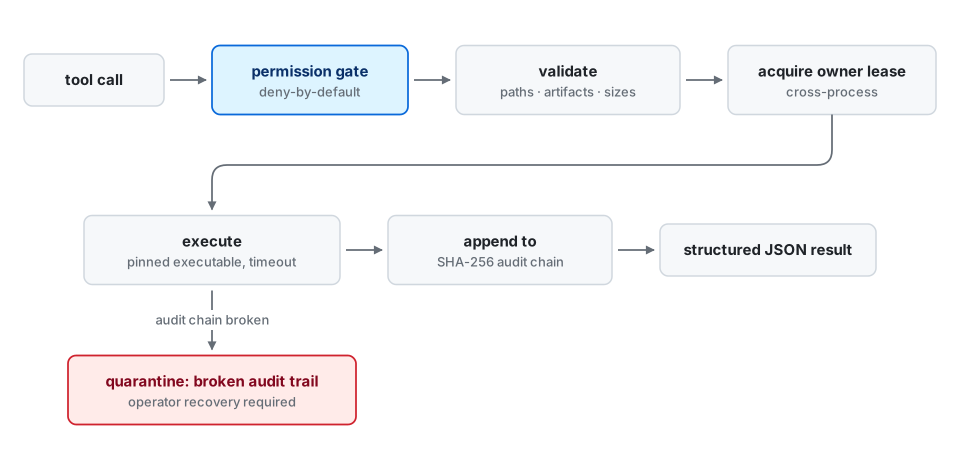
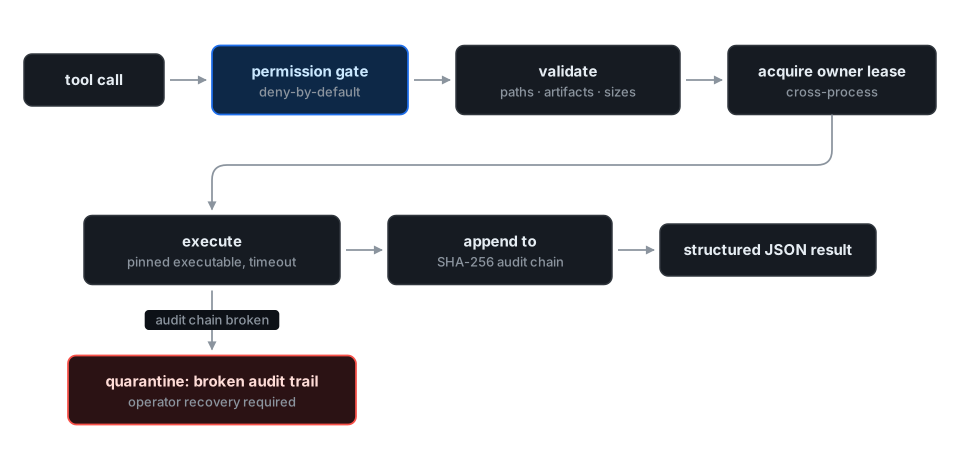
The gate is in the tool rather than in the agent's host because a probe, a port and a CAN adapter carry no permission model of their own, so enforcement has to sit directly in front of the hardware, the way a database engine and not its client holds the grants. A host's permission system is a second layer in front of this one and answers a different question; docs/security-design.md has why both exist.
Permissions and validation
- What is denied by default is presence: a device does not exist on this bench until the authoritative configuration declares it, and a call naming any other one is refused before a driver is opened:
unknown_devicewhere a run declares it, andcom_port_not_configuredorcan_bus_not_configuredwhere a port tool or a bus tool names it, each of those two naming the ones the configuration does declare. On a device it does declare, a generated configuration grants every permission that has a tool behind it (allow_flash,allow_resetandallow_debug_executionon a probe,allow_writeon a port and on a bus,allow_all_symbolsandallow_uploadon the project) and holdsallow_raw_debugger_commandsandallow_mass_erasefalse, the interlocked pair that has no tool behind it and refuses flashing while either is true. An operator takes one grant back withagentic-hil revoke <key>and reopens it withagentic-hil grant <key>, one named permission at a time, from their own shell and from nowhere else. Over MCP the direction is fixed: an agent narrows its own authority and never widens it, because a permissions write there may carryfalseand nevertrue.permission_deniedresults are authoritative and agents are instructed to stop (see AGENTS.md). - Opening a debug session and inspecting a halted target need nothing beyond
allow_probe(or, from version 2 on, nothing at all): the same read-needs-no-grant rule that covers the rest of this file, because an attach halts the core the way any other read does. Resuming it is a separate act and a separate grant,allow_debug_execution, checked ondebug_continueand nowhere else it could be reached from. A session that ends without the target's halt reconfirmed is not reported as a clean stop: it is held open for retry the way any other unconfirmed hardware effect is,safe_state_confirmed: falseandhalt_not_confirmed: truein the result, rather than let ending the session itself be the undocumented way to leave the core running. The breakpoints a session set are proved off the target on the same terms. A GDB that detaches takes them off itself, which is the proof wherever the debug server is still there to carry the detach; where the server has to be ended first so that it never resumes the core (pyocd gdbserverand ST-LINK_gdbserver), the session deletes them and reads the backend's own list back before that, and a removal the backend does not confirm is reported asbreakpoints_removed_confirmed: falseand held open for retry rather than returned as a clean stop. - Reading needs no permission, and exclusivity carries that load instead. The risk in a HIL tool is not damage but a false green: a test disturbed unnoticed produces a result nobody should trust. Whoever holds a board cannot be disturbed, and whoever reads while no run holds it disturbs nobody.
listen_onlyfor CAN remains the way to observe a target provably undisturbed. A port opened withassert_dtrandassert_rtsfalse keeps both lines released for the session, which is the least a serial observation does to a target, and it is not proved untouched by that: on Linux, measured with an FT232R over 65 opens, the open itself asserted DTR once for 239 to 943 microseconds before it was released for the rest of the session and at close, so a board that wires DTR to reset sees that pulse. listen_onlyis enforced per adapter rather than assumed, because the three adapters obtain the mode in three different ways.peaksets it through PCAN'sBusState.PASSIVE, re-asserts it once the channel is initialized, and readsPCAN_LISTEN_ONLYback from the driver.socketcanreads the kernel's control mode and never sets it: the mode belongs to the CAN netdev and onlyip linkputs it there, so an interface that is up without listen-only refuses the session rather than being joined by an ACKing node. Aprocessbridge is sent the flag and must answerlisten_only: truefrom itsopenresult; forwarding confirms nothing. An adapter that cannot be held to it refuses withcan_listen_only_unsupported(before the bus is touched) orcan_listen_only_unconfirmed(asked, not confirmed, adapter closed again), never with a silent downgrade;can_buses_listreportslisten_onlyandlisten_only_enforcementper bus. Transmitting on such a bus is refused rather than attempted:can_send, a test plan'scan_sendstep and a broker participant's send all answercan_listen_only_modebefore any driver is called, whateverpermissions.allow_writesays: the mode is settled first and the permission is never reached, because a bus is not made transmit-capable by granting a permission on it. Enforcement and verification reach exactly as far as the driver's or the kernel's own report of its mode; beyond that this product makes no claim.- Configured executables and OpenOCD scripts are pinned at startup and must resolve outside the workspace; firmware artifacts are validated, hashed, and staged in a private process directory before any backend consumes them.
- The MCP launcher that gets registered is pinned the same way and must be owned by the operator or by root, executable, and writable by nobody else, where group write counts as another writer only when the group is not the owner's own user-private group (its name is the account's, its gid is the account's primary gid, and it has no other member), so the group-writable console script a default Debian or Ubuntu
umask 0002produces is accepted as it stands while world write, a foreign group, and ownership by a third account stay refused with the failing condition and the path element named. - Serial/CAN writes and reads are size- and buffer-capped; debugger calls run with timeouts and OpenOCD's TCP servers disabled.
- One live owner per project and physical probe/port/bus across all entry points; a second process gets
resource_busy, and a crash or an unknown effect opens an incident on the resource (TROUBLESHOOTING.md). An incident is raised for a genuinely unknown physical state: a failure that proves it never reached the hardware (a missing toolchain, an unplugged probe or adapter, an unopenable port, a script refused before the adapter opened, a read whose backend reports that no target answered) refuses with a named error,target_contacted: falseandretry_safe: trueinstead. The proof has to be the backend's, not the tool's category: a read killed at its deadline still counts as contact, because an SWD attach halts the core and a killed process never ran its own shutdown. - An incident is not a padlock on the bench. A run that hits one aborts with the verdict
failed(recovering the bench never un-fails a test), and the abort drives a recovery action: reap, reset into halt whererecovery.auto_recoverand the probe'sallow_resetpermit it, then a probe re-read, all reported in the run result'srecoveryblock. The calls that are the remedy (probe_target,reset_target,flash_firmware) run while an incident is open and clear it when they answer the reason it names, with a ledger line. - A gate is only owed where the missing proof cannot come back on its own, so the standing, human-visible quarantine is the audit halt and nothing else. A target's state is proven by the next reset into halt and an answering probe; a serial handle's and a CAN adapter's by their own next open, which the operating system refuses by itself if the handle is really stuck. Those incidents end when the call that raised them ends, leaving a
no_standing_stateline in the recovery ledger that names every reason they were held for. The evidence chain is the one thing no later contact rebuilds, because no reset writes a report that was never written: anaudit_brokenincident holds the bench, refuses the stimulus class (com_write,can_send, session starts, new runs) withresource_quarantined, and is cleared only throughagentic-hil recover --confirm-safe-stateor, wherepermissions.allow_recoversays so,hardware_recovercarrying the operator's own words asoperator_statement. Both routes answernothing_to_recoveron everything else. - A result that names a
cleanup_reasoncarriesquarantine_guidancefor it either way: what was attempted, what is confirmed, what remains unknown, and the physical check to perform (for the operator, or for the agent to relay to them). - A debugger result is judged by the backend's own report of the run and not by the words anywhere in its transcript: an OpenOCD run that exits 0 and prints the success marker its command string
echoes after the operation is a success, because OpenOCD stops evaluating that string at the first command that fails and could never have reached theechootherwise. The failure-worded lines such a run printed come back on the successful result asbackend_warnings, verbatim, so a noisy build stays visible without a reset the board performed being reported as a failed one. A run without the marker, or one that exited non-zero, is classified exactly as before.
Exclusivity, incidents, audit
- Exclusivity per physical device is machine-wide and held for the whole run, kept in one agreed place (
~/.agentic-hil/device-locks) rather than beside a configuration, because two sessions with differentstate_rootvalues are still one bench. A contender is refused withdevice_busynaming the holder; waiting happens only when asked for (--wait-s) and is bounded. Ownership is the operating system's lock, so a crashed run frees its devices immediately, with no quarantine and no manual recovery. - Canonical reports and the tamper-evident audit chain live under the operator-pinned
state_root; workspace logs and reports are untrusted mirrors, verified against the chain on read.
The complete threat model and design rationale: docs/security-design.md. What each permission opens, and which ones a generated configuration writes false: the authoritative configuration.